Posts

Showing posts with the label motorcycles

The quintessential old Harley

Image
Mid-50s Harley has no saddle bags or other adornments to obscure its classic silhouette.      HERE'S THAT  Harley-Davidson from the last post, sans band members. It wasn't the oldest or rarest Harley at the meet, but it was my favourite – a 1955 or '56 (they're pretty much identical), finished in honest black and carrying, to my mind, just the right amount of chrome.    With 74-cubic-inch panhead engine, it could be a standard FL model, but given its Cuban heritage – plus the purple auxiliary headlamps – I'm guessing it's the police-issue FLE that was tuned for traffic control duties. The hand shifter for the gearbox is another clue: a majority of civilian buyers were opting for Harley's new foot shifter in the mid-50s, but police and military customers remained loyal to the hand control.    This is the last of my Harlista shots – at least for now. Time to turn back to cars and trucks. Maybe some buses, too.
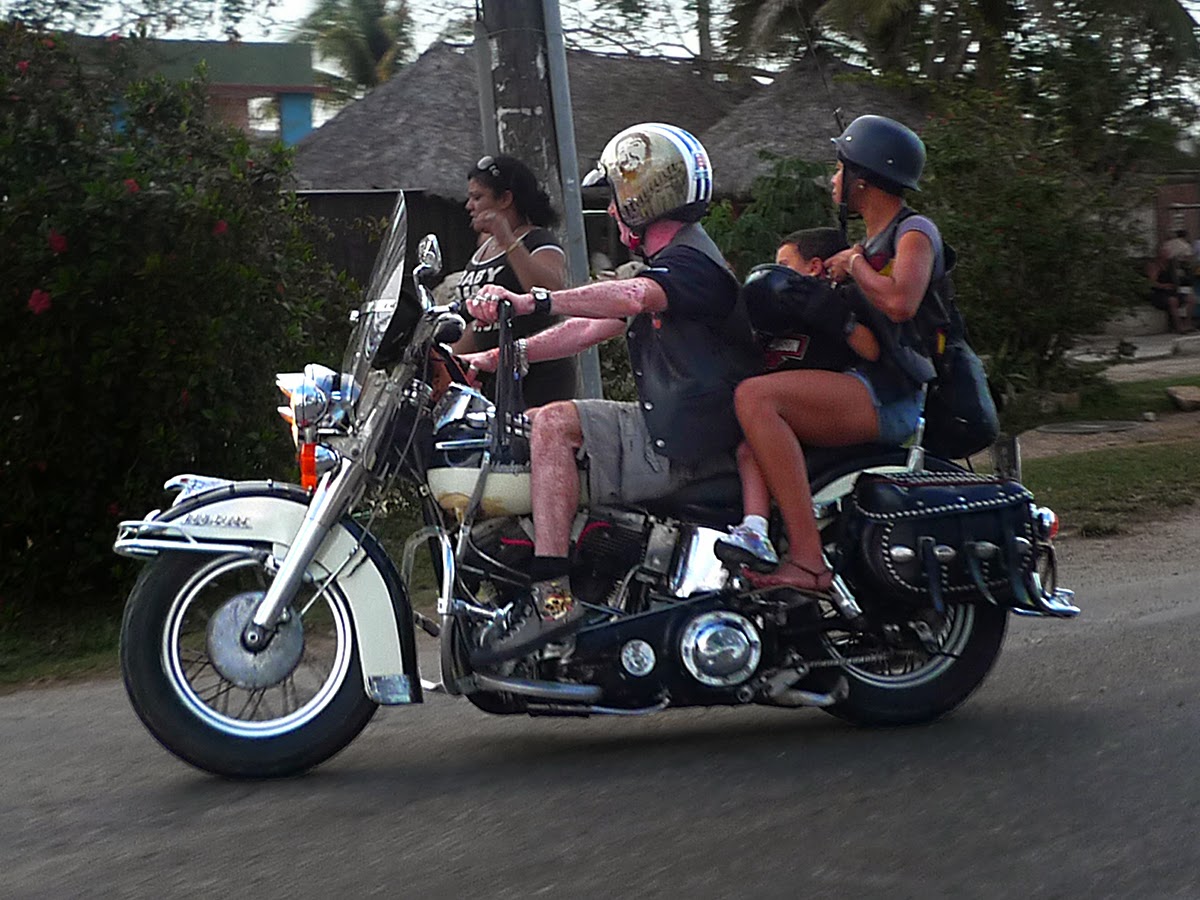
Riding three up

Image
I suspect it is as illegal in Cuba as it is elsewhere to have three people on a motorcycle (unless you have a sidecar), but you see it regularly. Fortunately, t his Harley-Davidson Duo-Glide is a family-sized bike. Older Flathead Harley-Davidson lacks the Duo-Glide's coil-over-shock rear suspension, but its rider-family appears comfortable.

Doing the Harley math

Image
      SO HOW  many Harleys are left in Cuba?    The Cubanharlistas website, citing the country's National Register of Vehicles, pegs the number at 150, of which about 80 are in regular use.    But organizers of this month's national gathering of Harlistas in Varadero put the number at 270 to 300, according to an Associated Press report . (Perhaps the organizers were talking about all pre-1960 motorcycles, and not just Harley-Davidsons.)    In the years before the Revolution, the Harley was known as the favoured ride of Cuba's police and military. Just how many were imported for such service, however, is another matter of debate.    Cubanharlistas says about 1,000. The AP report, again quoting the rally organizers, suggests 2,000.    Really, who's to know?    Still, even taking the higher number from the first set, and the lower number from the second, that leaves a lot of Harleys unaccounted for....

The legend of Cuba's lost Harley-Davidsons

Image
Harlistas with circa-1952 FL Hydra-Glide with side shifter.     PHILLIPPE DIEDERICH  was one of the first — perhaps the first — to chronicle Cuba's Harlista movement.    It was in March 1997, in the Miami New Times , that the Florida-based writer and photographer told of the island's Harley-Davidson owners and their singular devotion to the rumbling old machines.    Diederich wrote about the late mechanic José Lorenzo Cortez — nickname: Pepe Milésima — whose skills kept the big bikes going for decades after the Revolution, and Sergio Morales, the one-time apprentice to Cortez who would inherit his teacher's role as high priest to the island's Harleys.    He told how the Harlistas make crank pins out of Russian pressure bearings, craft perfect reproductions of Harley exhaust systems and retro-fit sorely needed rear shock absorbers to Hydra-Glides. Every Harley-Davidson in Cuba today is said to b...

That's no old plug

Image
  A fellow I know in Cuba told me he owned a 1950s BSA. "It's a chopper," he said.   I pictured some stripped-down veteran British machine, like the Matchless that Marlon Brando posed on during filming of The Wild One (in the movie, he rides a stock-looking Triumph 6T Thunderbird 650).   Before I went down this year, I looked for a pair of spark plugs to bring him. I couldn't find the Champions originally specified for his iron-head BSA, so I picked up the equivalent NGKs.   In Cuba, my friend showed me his bike. It turned out to be an extremely tidy custom with raked frame, stepped seat, the works. The "pre-unit" engine and transmission were original, but everything else looked to be hand-fabricated, adapted from donors bikes (there's a lot of Honda in it) or bought on the aftermarket.   Hardly the old rattler I had imagined.   He still seemed quite pleased with the spark plugs. Brando on the Matchless: 1953.

Another scooter sighting

Image
Flight of the bumblebee:  Čezeta scooter     I had seen the Čezeta scooter only in photographs. Then, one afternoon this month in Havana, I spotted not one but two real-life examples of the strange, Czechoslovakia-built two-wheeler.     Only in Cuba.     One was coming toward me on a highway; I caught just a glimpse of it. But the veteran Čezeta you see here, with bumblebee-theme paint job, was parked for my leisurely perusal on Avenue Maceo, between the harbour and the tourist-crowded Old Havana district.     The Čezeta is odd-looking enough in photos, the seeming result of a marriage of a torpedo with a coffee pot. See a real one and your reaction can only be: "Yikes!"     Yet this scooter was designed for practicality. Built from 1957 until 1964 by the merged motorcycle companies CZ and Jawa, the Čezeta has a long, dual saddle concealing a big luggage compartment; an optional trailer was avail...