Monday, January 24, 2011

Geely. Prounced Jee-lee. Or in Cuba, Heely
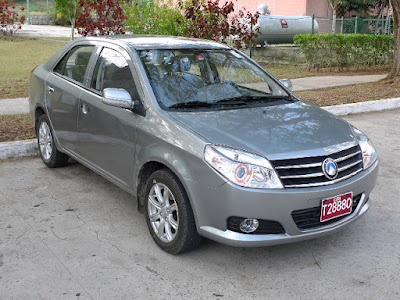

The Geely MK: Smart styling, uneven materials.

   Reserve a rental car for your Cuban holiday, and chances are you'll find a Geely waiting for you.
   A product of China's largest independent automaker, the Geely has become Cuba's fleet car of choice. Since 2008 Geely has supplied nearly 5,000 sedans to replace the island's much-travelled Hyundai taxis and rental cars, and its purely ancient Lada police cars. The manufacturer reports that it has orders for more cars, these with automatic transaxles, and has set up a parts depot in Cuba to support its growing presence.
  Geely is meant to be pronounced with a soft "g," as in Jili, a Mandarin word meaning auspicious or lucky. In Cuba, however, you're more likely to hear it as "Heely" -- not to be confused with those kamikaze roller-shoes of a few years ago.
  Geely is scarcely older than Heelys. Founded in 1986 by entrepreneur Li Shufu to make refrigerator parts, it expanded to motorcycles in 1994 and cars in 1998. Today, billionaire Li is among the richest residents of China (which, unlike Cuba, long ago moved away from a centrally planned economy).
  Cuba police get the Geely CK, a small sedan from the round-and-bland Asian design school of the early 2000s, but with some baby-Mercedes flair in its complex headlamps and sloping nose. Its inner working include a platform from Korea's Daewoo (pre General Motors acquisition) and a 1.5-litre engine licensed from Toyota.
Who stole the handle?
  I saw a CK at the 2006 Detroit Auto Show and remember its thin felt floor coverings. The CK is better known, however, for disastrous safety ratings. A Russian car magazine crash-tested a CK with no airbags and estimated the survival chance of driver and passenger at just 10 per cent. A South American test gave the CK a zero out of five potential stars for occupant protection. These safety concerns and the need to meet tough emission standards help explain why Geely has yet to enter the North American market.
  The Geelys I saw at my rental agency in Cuba were MKs, newer and larger than the CK and more distinctive in their styling, with slightly concave sides below a pronounced beltline crease that gives this model a sporty rake. Good news for renters: The MK sedan has achieved much better crash scores, earning a 3.5- to 4-star rating from Britain's certification agency, and a full five stars from the new testing agency in China (where, by the way, the MK is known as the Kingkong, not to be confused with the KrAZ truck also common in Cuba).
  Outside, the MKs looked well-finished, though not particularly rugged -- one was already missing some side trim, and another has lost its passenger door handle. I didn't rent one (I always seem to get the same Hyundai Accent), but I did take one for a spin.
  With rough edges, a hard-plastic dash and thin headliner (more of that carpet felt?), my car's interior didn't match the exterior quality. It did, however, contain power windows, air conditioning and other features you'd want, and its big, well-padded seats seemed up to standard.
  The engine started easily, though it was buzzier than those of competing small cars, and the clutch action in my manual-transmission car was uneven. Shift action, on the other hand, was emphatic, thanks to a stout, truck-worthy shift lever and heavy counterweights on the under-hood transmission linkage.
    The car rode along well enough in my short trip, and felt more substantial than its compact size would suggest. The rental staff told me the Geelys use more gas than the Hyundais.
   The MK is proof of both the speed of Geely's progress in just 13 years as carmaker and the difficulty of building to the modern automotive standard. It looks good and its operation is acceptable (and just a few years ago might have been considered praiseworthy), but it lacks the uniform quality of established automakers the world over. It reminded me a bit of the Volvos my family drove in the 1960s and '70s, cars with tank-like frames and headlamp switches that would come off in your hand.
   Volvo has moved upmarket, with overall quality levels today that are a match to its famous safety standard. And Volvo -- who'd have thought it? --  is lately owned by Geely, which picked up the Swedish carmaker from Ford Motor Co. for $1.5 billion U.S. in August 2010.
   The acquisition is the latest gamble for Li Shufu, who has promised to give Volvo "independence and autonomy." He wants to double its sales by 2015, and believes much of that growth can come in China.
   Even as Volvo expands, however, we can be sure that the brand's know-how and technology will be flowing to Li's other plants, and that future Geelys will be safer and better constructed because of it.
   Heelys, in contrast, don't seem to be getting any better.

The MK is larger than Geely's earlier CK, and has better safety ratings.


Wednesday, January 12, 2011

A Cushman, no, a Cusman, in Cuba


   Pretty scooters come from Italy. For those who instead wanted a rugged scooter, the source for three decades was Lincoln, Nebraska, home of the Cushman Corp. factory that turned out tough, reliable two-wheelers between 1936 and 1965.
   Cushman's most famous product? The Military Airborne Model 53, a foldable, lightweight scooter designed to be dropped with parachute troops in World War Two. It didn't work out so well on the battlefield, but is much valued by collectors today.
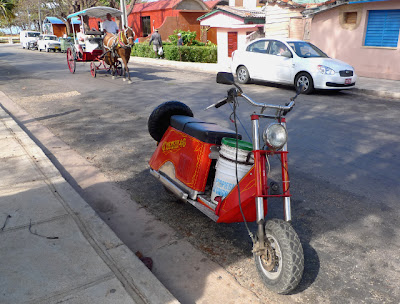
  I saw this step-through Model 52 or 54 Cushman -- never mind the missing "h" -- in Varadero. Built, as it says, in 1948, it's had some reworking over the years. The tube-style forks and front disc brake, for example, would have been later additions, and the cowling has received some well-executed aluminum patches. I couldn't tell if that cowling concealed the original 221-cc, 4-horsepower engine. The bucket, I figure, serves as storage compartment.
  The Cushman name lives on as a line of light industrial trucks produced by a subsidiary of Textron Inc. in Augusta, Georgia. And this '48 Cushman survives as an economical means of daily transportation in Cuba.


Thursday, January 6, 2011

The sweetest '55 in Cuba

   Maybe it's because we share a birth year, but I've always thought of the 1955 Chevrolet as the first car of the modern automotive era. Certainly, it merits landmark status for the eager small-block V-8 it introduced; descendants of that engine can be found all over, including under the hood of my 2009 pickup.
    But to me, it's the balance of the 55's proportions -- the roundness of its profile and the squareness of its stance -- that sets it apart. Look at it, and you see more of the cars that arrived later than those that came before.
For collectors, the '55 Chevy to have is the two-door Nomad station wagon, of which just 8,386 were built. But for my money (and I'd need a lot of it to buy one), the Bel Air convertible is nicer yet. Chevrolet made 41,292 of the ragtops, and you know every one was a smile-producer.
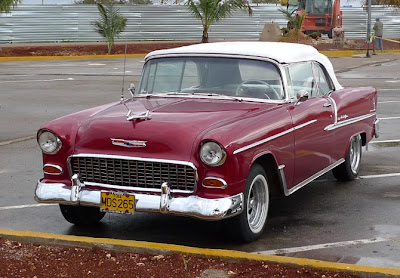
   Like this example parked at Juan Gualberto Gómez Airport. From bright grille to period-perfect Continental kit for the spare tire, this was a show-quality car. Notably, it remains in private ownership, unlike many of Cuba's best classic convertibles that now bear blue government plates and ferry tourists around Vedado.
   If there's a sweeter '55 on the island, I'd like to see it.

Saturday, January 1, 2011

Same 'Vette, different view


   Tony Robertson's image of a 1959 Chevrolet Corvette in Havana (Dec. 6, 2009: "Another Corvette in Cuba") continues to draw interest. This undated photo, supplied by a friend of CARISTAS, shows what is almost certainly the same car.